Phở Before Phở: Following the Broth Back Through History

Vietnamese cuisine features many dishes clearly influenced by French gastronomy, such as Baguette bread, Beef Bourguignon, Pâté Chaud, Choux Pastries, and Crème Caramel .These dishes serve as clear examples of culinary exchange during the French Colonial period.
However, Vietnam’s most iconic dish – phở – remains a far more complexquestion.
Did phở originate from French cuisine?
Some believe that phở evolved from pot-au-feu, a traditional French beefstew, noting the phonetic similarity between “feu”and “phở”.
Others argue that phở derives from niúròu fěn, a beef rice noodle dish from China’s Hunan Province.
So which explanation is more plausible?
Let Ancient Huế revisit historical sources to approach this question with greater nuance and care.
From a structural perspective, phở consists of three essential components:
- Rice noodles (bánh phở)Broth
- Meat and accompanying toppings
1.Rice noodles
At its core, bánh phở is a type of rice noodle, widely found across Southeast Asia (Thai lan have Pad and Southern China have its version too).
While regional variations exist in texture, width, and length, the underlying technique remains consistent: grinding rice, steaming ricesheets, and slicing them into noodles.
To date, no historical document definitively identifies when or where rice noodles first appeared. Given their long-standing presence across southern East Asia, many scholars suggest that early rice noodle–making techniques may be linked to the cultural sphere of the Baiyue (Bách Việt)—a broad constellation of non-unified, autonomous communities inhabiting a region stretching from southern China to northern Vietnam. These societies existed well before the 2nd century BCE and gradually disappeared as distinct cultural entities following the southward expansion and political consolidation of imperial China.
Notably, this region is characterized by:
- A strong reliance on wet-rice agricultureA culinary culture in which rice occupies a central role
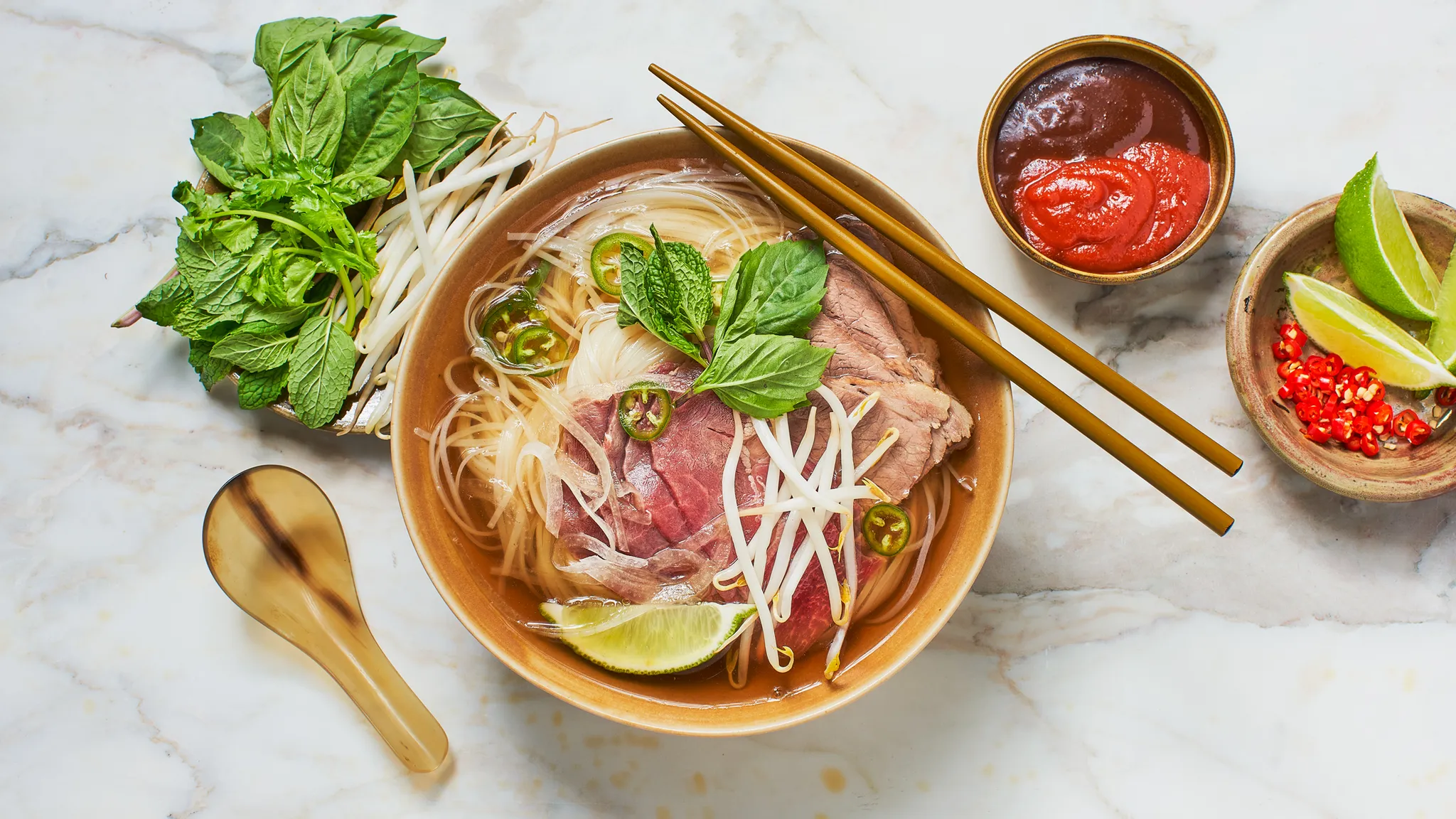
Pho has existed for a very long time. Before pho was servedas a noodle soup, Vietnamese people ate the rice noodles mixed with fish sauceand fresh herbs, similar to a noodle salad. Most notably, pho was traditionally eaten together with a specialty dish that has since disappeared, which will beintroduced in the next section.
Pic 1 : Photo by Heami Lee, food styling by Judy Haubert, prop styling by Rebecca Bartoshesky
2. Broth – nước dùng
Pot-au-feu and the Broth of Phở
Pot-au-feu is prepared by slowly simmering beefbones with onions, carrots, celery, thyme, turnips, and potatoes—a method thatappears remarkably similar to the way phở broth is made.
The key differences, however, lie in thearomatic foundation. Phở does not include potatoes or celery;and western spicelike thyme, mustard seed and parsley, instead, drawing from a long-standing Vietnamese and Southeast Asian spice tradition, its broth is built around warm, fragrant spices such ascinnamon, star anise, and ginger, creating a distinctly local aromaticprofile.
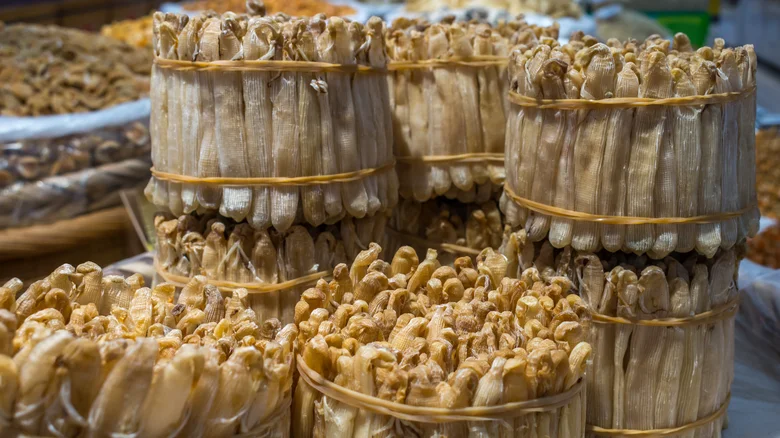
Sá sùng – a distinctive Vietnamese umami source
Most notably, Vietnamese cooking has long included an ingredient that is not rare,yet rarely used in other culinary traditions:
Sá sùng— also known as peanut worm — aliteral umami bomb.
Once harvested, sá sùng is sun-dried immediately on site, apractice that preserves freshness and results in a product of exceptionallyhigh quality. This method is closely tied to tropical coastal environments, where strong, consistentsunlight allows natural drying to take place year-round.
During this natural aging process—much like the aging of steak or other meats—endogenousenzymes break down proteins, concentrating amino acids that areresponsible for umami and depth of flavor, particularly:
· Glutamicacid → deep, rounded savory sweetness (similar to natural MSG)
· Glycine& Alanine → lingering sweetness and meaty notes
· Asparticacid → enhanced depth and complexity
Additionally, dried marine products contribute a distinctive “oceanic” character,a subtle yet unmistakable sense of the sea that adds further dimension to thebroth.
Today, the technology behind highly concentrated powdered MSG has become extremely advanced. As a result, natural umami ingredients that are both traditional and expensive—such as peanut worm (sá sùng)—are no longer widely used. The price of dried peanut worm is now nearly ten times higher than that of fresh beef by weight.
For this reason, peanut worm is most commonly found in home-cooked pots of phở, where cost efficiency is not a primary concern. In commercial phở operations, which require a stable supply chain and clear profit margins, few vendors are willing to use it. Used generously, it drives costs too high; used sparingly, it fails to create a perceptible difference in flavor.
However, for phở kitchens committed to a purely natural flavor philosophy, peanut worm remains indispensable, contributing depth, natural sweetness, and a lingering umami finish to the broth.
Xáo Trâu – a pre-existing Vietnamese predecessor
As mentioned earlier, long before the concept of pot-au-feu was known in Vietnam,local culinary traditions—particularly in NamĐịnh Province—already featured a dish known as Xáo Trâu, often regarded as a direct predecessor of phở.
Rather than beef, this version traditionallyused water buffalo meat, apractice that still survives today in certain regions where phở made with buffalo remains common.
Xáo trâu consists of rice noodles served with stir-fried buffalo meat, often stir-friedwith star fruit (khế) andaromatics, including onions and ginger,elements that are still recognizable in phở today.
Unlike modern phở, however, xáo trâu was not tied exclusively to rice noodles.Depending on household preference, it could be eaten with rice noodles, bún, or even plain rice,reflecting a more flexible, everyday approach to the dish.
Perhaps for these reasons, it is widely said in Vietnam that phở originates from Nam Định. It is possible that phở emerged from this culinary context—evolving as a more “pot-au-feu–like” interpretation of xáo trâu.While still eaten with rice noodles and beef, phở introduced a lighter,clearer, and more refined broth, elevating the dish into somethingmore delicate and nuanced.
In this sense, whether phở emerged through a sudden moment of invention or a gradual process of refinement remains unknown. All attempts to trace its origins are, at best, informed efforts rather than definitive conclusions, as no single, authoritative source can precisely identify the dish’s beginning.
A Small History Fact
A relevant historical context further clarifiesthis practice. During the Lý and Trần Dynasties, the slaughter of buffalo and cattle was strictly prohibited. These animals were essential to wet-rice agriculture, valued primarily for plowing and farm labor rather than for consumption. As a result, xáo trâu was typically prepared only when animalshad grown old or were nearing the end of their working lives.
3. Toppings
The use of beef is almost certainly influenced by French culinary practices, as Vietnamese cuisine traditionally did not center around beef consumption.
Earlier and more locally rooted variations—such as those using water buffalo or chicken—align more closely with longstanding Vietnamese culinary traditions.
The earliest documented reference to phở is
Existing historical records suggest that the term “phở” appeared relatively late in written documentation.
The earliest known reference to date is found in “Technique du peuple Annamite” (1908–1909) by Henri Oger.
Henri Oger (full name Henri-Joseph Oger) was a French volunteer who served in northern Vietnam (Tonkin). He is best known for his extensive collection of woodblock-style drawings and sketches depicting the everyday life of the Vietnamese people in the early 20th century. Within this work, illustrations of itinerant phở vendors in Hanoi appear clearly, indicating that phở was already part of urban life at the time.
Subsequent sources further confirm the establishment of phở as a distinct dish. Notably, the 1920 dictionary published by the École française d’Extrême-Orient (EFEO) provided clear definitions of phở and its variations, including phở chín and phở tái, demonstrating that the dish had by then become formally recognized and categorized.
Pic 2 : Peanut worm after the drying process.